Logistics operations dashboard showing AI-assisted shipment tracking and supply chain automation

AI Workflow Automation for Logistics & Supply Chain

Cut manual tracking, automate supplier communications, and get real-time visibility across your supply chain. Practical AI workflows that reduce operational overhead in weeks.

Logistics and supply chain businesses run on coordination — between warehouses, carriers, suppliers, and customers. The pain isn't a lack of data; it's that data sits in emails, spreadsheets, carrier portals, and WMS screens that don't talk to each other.

We deploy AI that bridges those systems: reads the shipment update, matches it against the order, flags the exception, and tells the right person before the customer calls to complain.

Common Operational Pain Points

Where logistics & supply chain teams lose time

Shipment status lives in too many places

Tracking updates arrive via email, carrier portals, EDI, and phone calls. Operations staff spend hours consolidating status across systems instead of managing exceptions.

Supplier and carrier communications are manual

Every booking confirmation, delay notification, and ETA request is a separate email or call. The same information gets re-keyed across WMS, TMS, and customer-facing systems.

Warehouse receiving is slow and error-prone

Goods arrive with packing lists that don't match the PO. Staff manually check, count, and reconcile before anything hits the system — creating bottlenecks at the dock.

Customer delivery queries overwhelm the team

Customers call or email asking 'where's my order?' and staff scramble across systems to find an answer. Response time is slow and inconsistent.

How It Works

Automated workflows in action

Each workflow connects to your existing systems. No rip-and-replace required.

Shipment Exception Management

Trigger: Carrier tracking update received (email, API, or EDI)

  1. 1AI parses tracking update and maps to internal shipment reference
  2. 2Compares actual status against expected timeline
  3. 3Flags delays, missed pickups, or routing anomalies
  4. 4Alerts the responsible operations manager with context and suggested action
  5. 5Logs resolution for reporting and carrier performance tracking
Outcome

Exceptions caught hours earlier, fewer customer complaints

Exception detection: 4–8 hours faster than manual checks

Goods-In Receipt Automation

Trigger: Delivery arrives at warehouse dock

  1. 1Packing list scanned or photographed at the dock
  2. 2AI extracts line items and matches against PO and ASN
  3. 3Quantity and item discrepancies flagged immediately
  4. 4Clean receipts auto-posted to WMS with audit trail
  5. 5Discrepancies routed to procurement for resolution
Outcome

Receiving throughput doubles with fewer put-away errors

Goods-in processing: 15–20 min → 3–5 min per delivery

Customer Delivery Query Resolution

Trigger: Customer asks 'where's my order?' via email or chat

  1. 1AI identifies order reference from customer message
  2. 2Pulls latest tracking status from consolidated shipment data
  3. 3Generates a customer-friendly status update with ETA
  4. 4Sends response automatically for standard queries
  5. 5Escalates complex issues to a human with full context
Outcome

Customers get answers in seconds instead of hours

Delivery queries: 40–60% resolved without human intervention

Before & after automation

Shipment status checks
Before: Manual across 3–5 carrier portals
Single consolidated view with auto-alerts
Supplier communication
Before: Hours of manual emails per day
Auto-generated with human approval
Goods-in processing
Before: 15–20 min per delivery
3–5 min with auto-matching
Customer delivery queries
Before: 15–30 min response time
Instant self-service for common queries
Stockout frequency
Before: Reactive reordering
30–50% fewer stockouts with forecasting

Measurable impact

Real numbers from real logistics & supply chain engagements.

60–80%

Less time on manual shipment status checks

2–3×

Faster goods-in processing at the dock

40–60%

Delivery queries resolved without human intervention

15–25%

Reduction in held-stock value

Logistics & Supply Chain

Top 5 most common use cases

Each ships in weeks, not quarters, with a clear ROI signal. Pick one, prove the value, then scale.

1

Shipment tracking consolidation & exception alerts

Ingest tracking updates from carriers (email, API, EDI, portal scrape), normalise into a single timeline per shipment, and alert operations only when something is off-track or needs action.
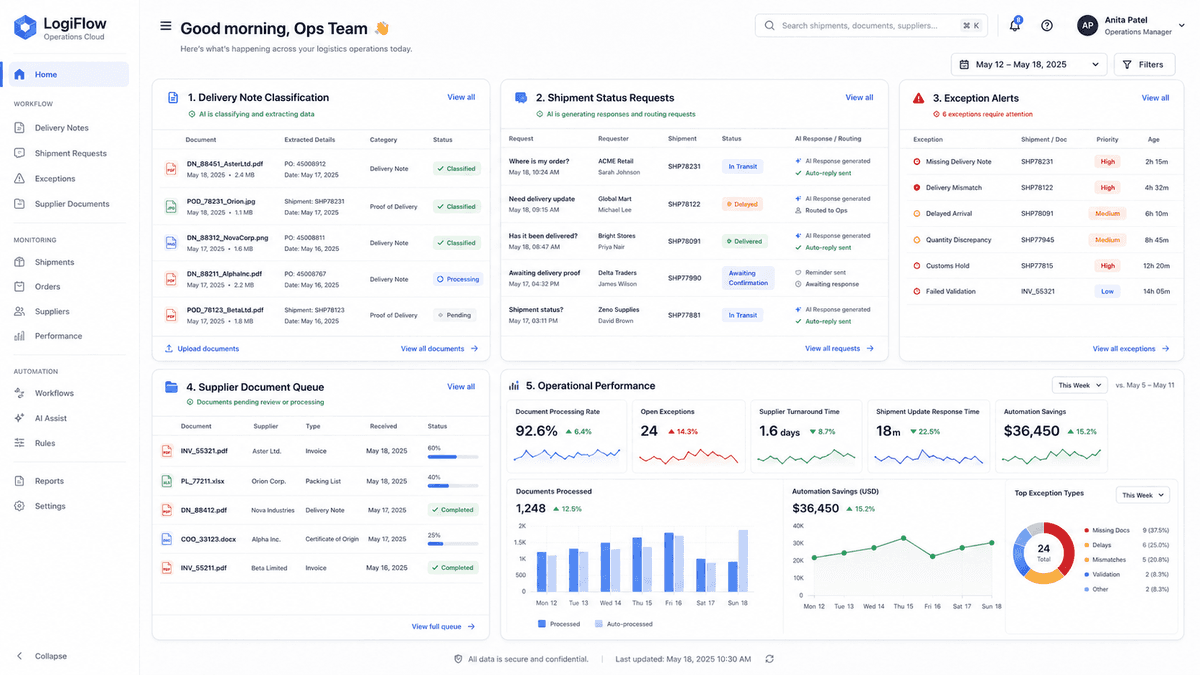
Operations team spends 60–80% less time on status checks; exceptions surface hours earlier than manual monitoring.

LLM email parsingCarrier APIsn8nWMS / TMS connector
2

Supplier communication automation

Auto-generate booking confirmations, delay notifications, and ETA requests based on order status changes. Route supplier responses to the right internal team with structured context.

Cuts supplier communication admin by 50–70%; response time to suppliers drops from hours to minutes.

LLM draftingEmail / EDI integrationTMSApproval workflow
3

Goods-in receipt matching & discrepancy flagging

Read packing lists (paper or digital), match against PO and ASN data, flag quantity or item discrepancies before goods are put away. Clean receipts auto-post to the WMS.

Receiving throughput improves 2–3×; discrepancy resolution time drops from days to hours.

OCR + vision LLMWMS APIBarcode / RFID bridgen8n
4

Customer delivery status self-service

An AI agent that answers 'where's my order?' from your tracking data, proactively notifies customers of delays, and escalates complex queries to a human with full context.

Deflects 40–60% of delivery status enquiries; customer satisfaction improves through faster, consistent answers.

RAG over tracking dataChat widget / email botCRM / helpdesk
5

Demand and inventory forecasting

Forecast model that combines sales history, supplier lead times, and seasonal patterns to recommend reorder points and safety stock levels across your SKU range.

Held-stock value typically drops 15–25%; stockout frequency reduced by 30–50% on forecasted SKUs.

Time-series MLWMS / ERP dataPower BI / LookerAlert triggers

Logistics & Supply Chain — frequently asked questions

We use multiple carriers with different tracking formats — can you consolidate them?+
Yes. We parse tracking updates from any source — API, email, EDI, even carrier portal scrapes. The AI normalises everything into a single timeline per shipment regardless of carrier or format.
Our WMS is legacy and doesn't have a modern API. Will it work?+
We integrate via whatever your WMS supports — REST API, ODBC, flat-file export, or screen scrape as a last resort. The AI layer is decoupled from your system of record, so upgrading later doesn't break the automation.
How accurate is the goods-in matching for messy packing lists?+
Modern vision-LLM pipelines handle handwritten, printed, and photographed packing lists at 95–98% accuracy. We benchmark on your real supplier mix during the pilot and set a confidence threshold — anything below it routes to a human.
What does a typical first engagement look like?+
A scoped 4–6 week pilot on one workflow (usually shipment tracking or goods-in receipt), fixed-price. We only recommend scaling once the pilot hits a pre-agreed ROI threshold on your real operations data.

Our 6-Step Approach

From process friction to measurable impact.

We help SMEs design and deploy AI-powered workflow automation that delivers real results — safely, efficiently, and with your team in control.

01

Workflow Review

We map the manual process end-to-end: systems involved, current time cost, error points, and business impact.

60–90 minutes
Workflow map and automation opportunity summary
02

Bottleneck Prioritisation

We select the workflow with the strongest mix of pain, feasibility, and measurable ROI — so you start where it matters most.

2–3 working days
Prioritised workflow and success criteria
03

Prototype Build

We build a small AI-assisted workflow using your sample data, screenshots, exports, or existing documents. No dummy demos.

10–14 working days
Working prototype or interactive demo
04

Human Review and Controls

We add review points, exception handling, confidence thresholds, and fallback rules — so nothing runs unsupervised until you trust it.

Included in prototype
Controlled workflow ready for pilot
05

Pilot and Measurement

We test the workflow with real users and measure time saved, errors reduced, and adoption issues before scaling anything.

2–4 weeks
Pilot report and scale recommendation
06

Deploy or Improve

We scale the workflow and integrate it properly — or stop if the numbers do not justify further spend. No lock-in.

Based on pilot results
Deployment plan or improvement backlog

Practical and Proven

A structured approach focused on real business outcomes.

Human-Centred by Design

Automation with the right controls, transparency, and accountability.

Continuous Value

Measure, learn, and improve — so your operations keep getting better.

Free Logistics Workflow Audit

30 minutes. We review your biggest operational bottleneck — whether it's tracking, receiving, or customer queries — estimate the savings, and tell you honestly whether automation is worth it.

Book Your Free Audit